
How to accommodate the “learning through questions” gap
And the impact of exclusion, t-shirts, SCERTs, Alice Wong, maturing, community schools aren't community
In this issue…
How to accommodate the “learning through questions” gap (Nov 18)
How kids in community public schools aren’t actually in community (Nov 24)
What I’m reading and listening to…
Finally found this post I made a while ago that listed out soooo many examples of how non-speaking kids communicate. Someone from the UK wanted it for a presentation they’re doing, so I dug it up:

Danny with Words answers some good questions about facilitated communication!
A reader of my blog, and a parent to a segregated kid, is doing Master’s research about children aged 0-5 and systemic issues around exclusion. She has this survey and is especially interested in voices of those experiencing life with disabilities, minority status, and/or living in poverty.
New Disabled South has a new docuseries called Dual: The True Cost of Care. It follows 14 people in 14 Southern states as they share what it really takes to survive while dual-enrolled. Their stories reveal how policy shapes daily life and how the promise of care often falls short. You can also find it as a podcast if you prefer!
OMazing Kids just did an updated post about how you can get the most affordable pocket-sized AAC Affordable, pocket-sized AAC
From Bri, a non-speaking autistic teenager and activist
Post becoming a typer, people mainly look at me closer to how I see myself. I can’t describe how painful and damaging it is to be considered half human and spoken to and about that way. Years have passed and I still have anger living inside my body. I truly can’t imagine being a teenager or older and still being treated that way.
A- says presume competence via t-shirts (Nov 14)
There’s been a lot of annoying, ignorant convos about “presume competence”.
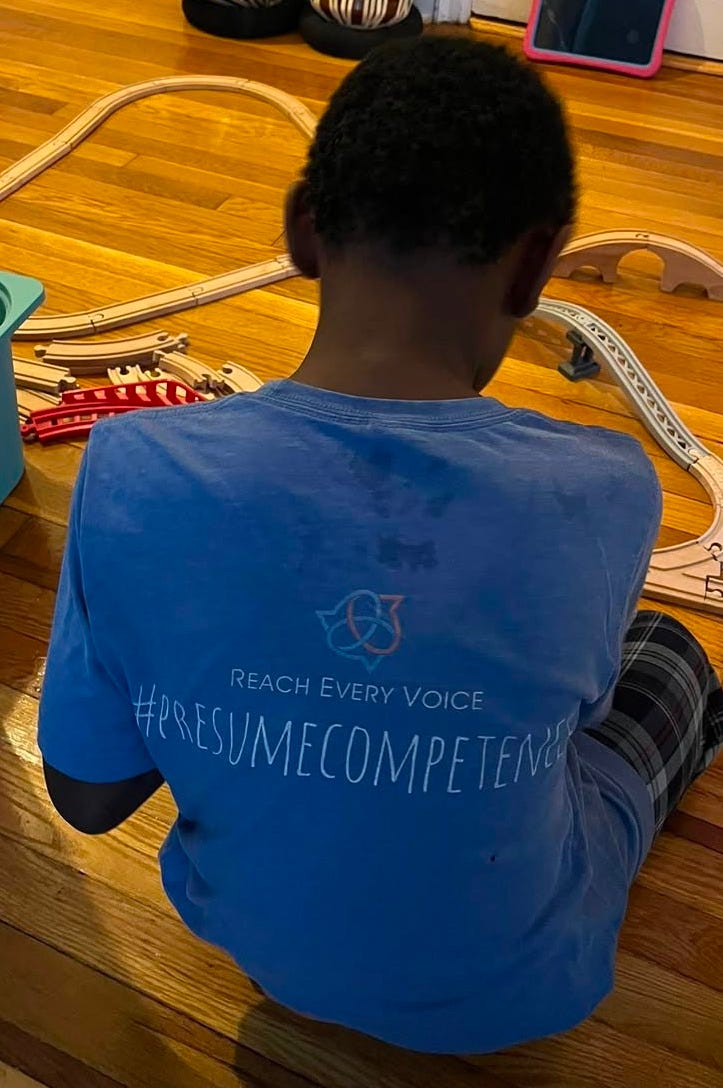
I just wanted to share this mornings t-shirt moment. I was getting my shirt to go have a shower and A- demanded I show it to him. Then when I did, he took off his own shirt (by himself!!! He was ready!!). So I gave him my shirt to wear, as he requested.
It was this one by REV! The front says “not being able to speak is not the same as having nothing to say”. (Or something like that. I can’t see it now).
The back says presume competence.
I guess I’m getting A- his second shirt!
Some more things about SCERTS and frameworks (Nov 15)
This is a follow-up from last week’s newsletter.
Wow! Jennifer Cronk shared this video with me that is by one of the SCERTS experts, and is on the STAR Institute, and is only 6 years old.
No part of this is what I want for my kid. Near the end, they’re very explicit about how the goal eventually would be to have conversations in a socially appropriate way including what topics to talk about, for how long, etc.
For kids who have no symbolic communication (not sure how we’d know) it’s making kids feel comfortable and captivated around people, and helping parents do that, because apparently we don’t know how.
But overall, the framing of this is still, at the heart of it, “Here are the 3 MAIN things EVERY autistic kid needs to improve to be.... better (a better person? A better... student..?). and they can all do it in this very specific way.”
And I know some people reading this seem to be really into defending SCERTS.
1 - Because Barry Prizant. If there’s one thing I’ve learned as a parent to a disabled kid it’s that we can NOT depend on something being true just because a nice person we really trust has said it’s good. It’s been a hard lesson for me. Some people that I LOVE and RESPECT DEEPLY with 95% of the things they say, also say something that is just wrong and harmful. *I* say and do things, I’m sure, that are wrong and harmful.
Ableism is SO ENGRAINED in us all, so, so, deep inside, that NONE of us get it all right.
We can respect someone, and still critique, or ignore, some of what they do.
2 - Because it’s better than what’s out there. THAT I agree with. I don’t have to deal with the school system, but I know enough to know there are some incredibly ableist therapists and teachers who are NEVER going to improve. They are NEVER going to do the hard work of actually seeing disabled people as people. They are NEVER going to do the hard work of interrogating their beliefs, their desires for frameworks and checkboxes to feel comfortable, they are NEVER going to push themselves out of their comfort zones even at the risk of getting things wrong, but learning and growing. And so I get why you’d want to offer them something that is LESS harmful than whatever they’re doing right now.
But this blog isn’t about the important work of harm reduction. This blog is about raising the best f-ing kids we possibly can.
Free, liberated kids with self respect, who are revolutionary just for being, with all the joy and pain that brings.
And it’s definitely not a blog to protect any adult’s feelings. It’s a blog to help other caregivers of kids like A- grow, just like I’m growing, despite all our mistakes and ableism and the ways we have harmed others in the past. To offer something completely and totally different. Not just lipstick on a pig.
—-
Nov 23
There’s a little bit of social media love being given to SCERTS now being recognized as something or the other in the US and being on a path to insurance covering it.
This is the problem when we only define what we’re doing by what we are moving away from - ABA - instead of where we want to go.
It means that yes, we are taking steps. But in what direction? We aren’t taking steps in the direction we want to be. We’re just taking steps... randomly... away from what we hate.
And I hear some people say “it’s better than ABA”. I’ve spent a LOT of time thinking about activism steeped in incremental change.
Before my current work, I worked for a criminal legal system direct services org that offered alternatives to incarceration. The ED prided itself on “incremental change”.
I really, really believe what that organization does is really important. We can’t underestimate the positive impact on the individuals who got to do that program instead of being in prison.
But it doesn’t get us to where we want to be. It’s a band-aid, an important one, while we try to have REAL change. And it’s important to see it, and name it, as that.
Because people say the thing about inclusion. That having classes like NEST or having some disabled people get accommodations in school is a path towards inclusion. And yet, I remember hearing on an episode of Maryland Coalition for Inclusive Education that at our current pace it will take something like 350 years for full inclusion of all disabled kids. 350 years!!!! Think about all the fascist eras that 350 years would allow to come in and wipe us back out to the beginning again.
And this brings me to the last point, which is the privilege it takes to say “YAY!!! We did this great thing that’s better than the awful thing!!!!”. Because it’s only those families and kids who have proximity to neurotypicality and are white who get to say “YAY!!!! We have the NEST program and that’s great for me so it’s great for everyone!!! And don’t worry A-, in 350 years someone like you will also get to be included!”
It’s only those with that privilege - the very well off white man who was the ED of my old org, the speaking neurodivergent or neurotypical person who’s been able to be an academic or top professional - who gets to say “YAY!!!! We should celebrate this thing that we made that still isn’t steeped in the values that autistic people want to get to but it’s not ABA!!!!”
We can’t settle. The experts and leaders CANNOT model settling.
(And as @jennifer cronk has eloquently said, SCERTS is actually not better than ABA anyway! In fact, on the SCERTS website is BCBAs saying the good news is you can be a BCBA and get trained in SCERTS and implement SCERTS in your ABA practice!)
Love to Alice Wong (Nov 15)
My heart is so warm seeing SO MANY people who Alice has known and touched. So I want to share mine! I didn’t know her, but there’s all these small ways in which I’ve been near her.
I did once meet with her because she was an organizer connected to my organization, MediaJustice. She connected us with other folks to help our org embark on a DJ 101 series.
She was a board member of 18MR (Organizing Asian America) when my friend was also a board member there. I’m now a board member there! But we didn’t overlap :)
And then she was a board member for Communication First! Which felt like the first time my non-parenting life overlapped so neatly with my parenting life.
All of this points to how she understood that the movement - for liberation, for freedom - was all interconnected. Whether it’s organizing Asian Americans, or fighting against Big Tech and Big Media, or uniting those who communicate without speech, or saving and liberating Palestinians, or disability joy. They’re all the same thing, and she lived that beautifully.
When I told Daniel this morning, he said that he had just recently listened to the Radiolab episode Voice because she was in it (he doesn’t listen to the show anymore). And he said she was SO GOOD. The other half of the show was meh, but he said her half is really worth listening to. I’ll link to the episode in the comments.
Cricut knock-off shirt! (Nov 17)
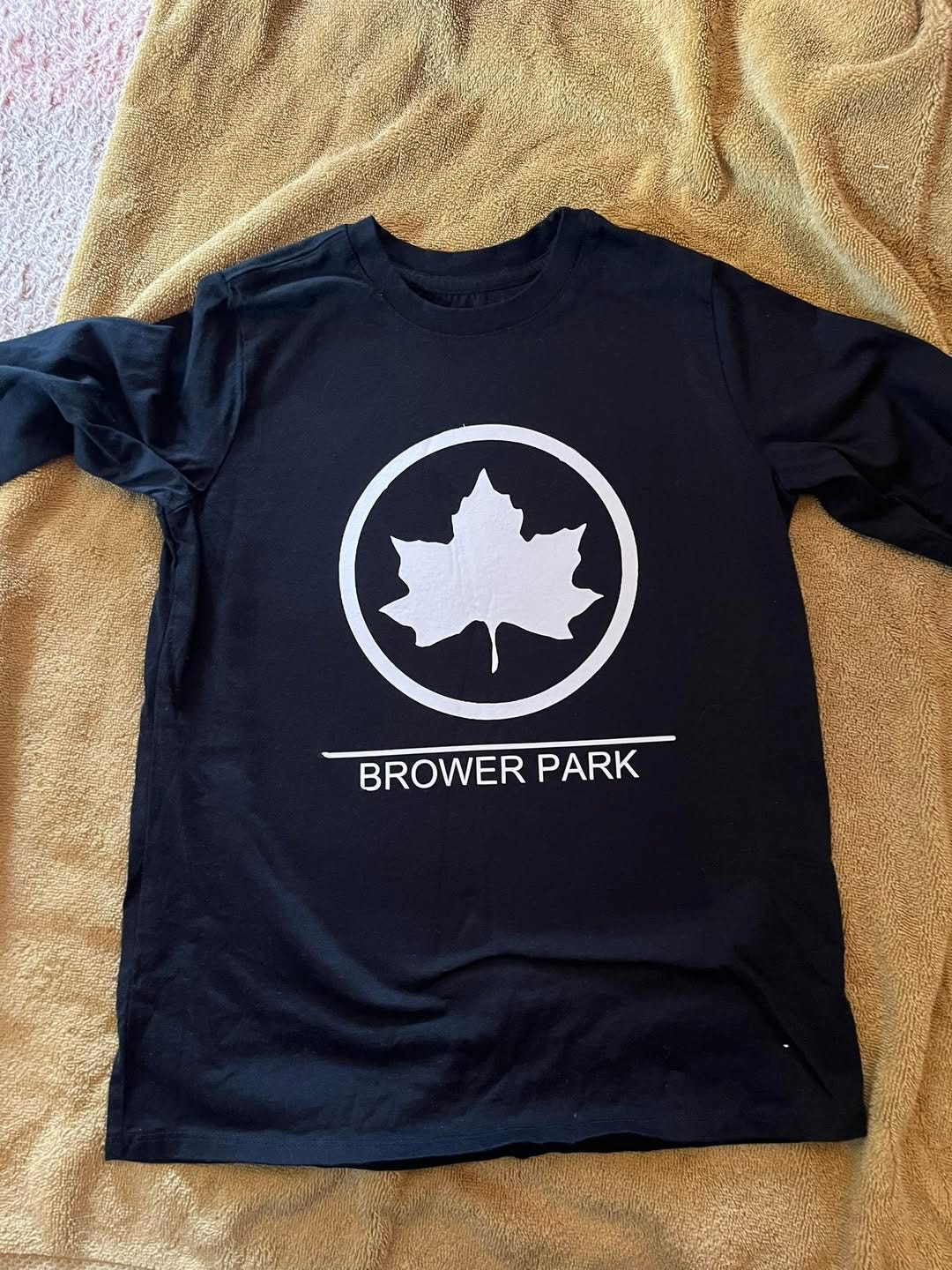
My second shirt with my Cricut knock off! Brower Park is our local park. A- loved it!
(I did a bunch of things wrong but it worked. We’ll see how many washes it goes through).
How to accommodate the “learning through questions” gap (Nov 18)
More on needing a term for “learning through questions” and how to be explicit for those who can’t.
I’m in a parenting group where someone was asking for advice around how to tell their kids (or not) that their aunt is having a schizophrenic episode and won’t be around for the holidays.
Various opinions around this, but that isn’t the point of my post.
The kids are 4 and 8, and one person’s advice which I think was the best is don’t answer more than what your kids ask, and answer directly and honestly.
For most kids this seems like really good advice to me! And is probably how most people parent and teach, whether they explicitly know they’re doing that or not.
So this is why we have to name when this isn’t possible for a kid and be really explicit around how we make up this gap.
(And no it’s not a framework. It’s just a statement of the reality of the world. Like gravity. And you can either focus your energy on making up for this gap, or do behavioral therapies or reward charts).
The impact of excluding our child (Nov 18)
I just did Bonnie’s research survey. And here’s what I wrote in the comments section in response to What I want to share with practitioners about the impact of exclusion on your child. This is about my kid but it isn’t.
----------
Every single day people stare at my non-speaking Black son. Kids and adults. At best, they stare without making comments. At worst, they threaten us and yell at him. Of course, they’ve never been around people like my son unless they have a family member who is disabled like him. From the age of 3, he’s been told he has to be segregated from school. School is basically the beginning blocks of community for children. What they know when they’re 3, they’ll know when they’re 5, then 10, then 15, then 20, then an adult. Like me and you.
I did not know anyone like my son until ... my son. I looked at non-speaking people and made quick assumptions and judgement. I never got the benefit of having them in my community, and so I thought they didn’t exist. I looked through them.
The consequence of my kid being excluded at the age of 3, is that he will continue to be excluded as he grows up. And the consequence of that is that he is believed to not exist. And when he is seen, it is through angry, scared, eyes. And the consequence of that will be his institutionalization or death.
It is not at all an exaggeration to say that when we exclude the most marginalized people when they are 3 years old, we are signing them up for their ultimate demise.
We can choose to change that. But we choose not to.
A small example of A-’s maturity (Nov 18)
From Daniel... Just a small example of A-’s maturity:
His hat fell off and I said “Your hat fell off”. And he put down the talker, long blue bus and water bottle gently one at a time and then picked up hat and patiently pulled it down over his head and adjusted it.
It’s a small thing, but it’s something that wouldn’t have happened before.
If he was in a lot of therapy, they’d take credit. But this is all him. (And if it’s your kid, and your kid is in a lot of therapy, it may actually just be your kid too. Your kid deserves the credit).
How kids in community public schools aren’t actually in community (Nov 24)
I wrote a post on my personal page reflecting on some differences I’m noticing between our neighborhood, and this neighborhood we’re staying in in Toronto.
But writing it made me realize... kids in schools, even in public community schools, are actually NOT experiencing the full experience of community. They’re getting a narrower version of community. One that doesn’t include A-, and other kids like A-.
Those kids are being excluded from kids like A-. Sad for them. Because A- is so cool.
Thank you very much for sharing these writings, I always learn from them. Alice Wong touched my life as well and helped me undo some of my own ableism and harm reduction (among the many, many others she touched.)
The harm reduction part is also very interesting and good metaphorical food for thought. I think these days I have been so focused on avoiding institutionalization that everything has started to seem increasingly relative/life often does feel like going with the least harmful option and finding it to be great if it is e.g. 50% less harmful than I expected? But I have kind of lost sight of things outside of harm reduction so I appreciate the insight.